
Dutch Regulator Fines SkyHills and Instantcasino Operator a Record €37 Million
The Dutch KSA fined EOD Code SRL, operator of Instantcasino, SkyHills and 10 other sites, a record €37 million for illegal gambling aimed at Dutch players.
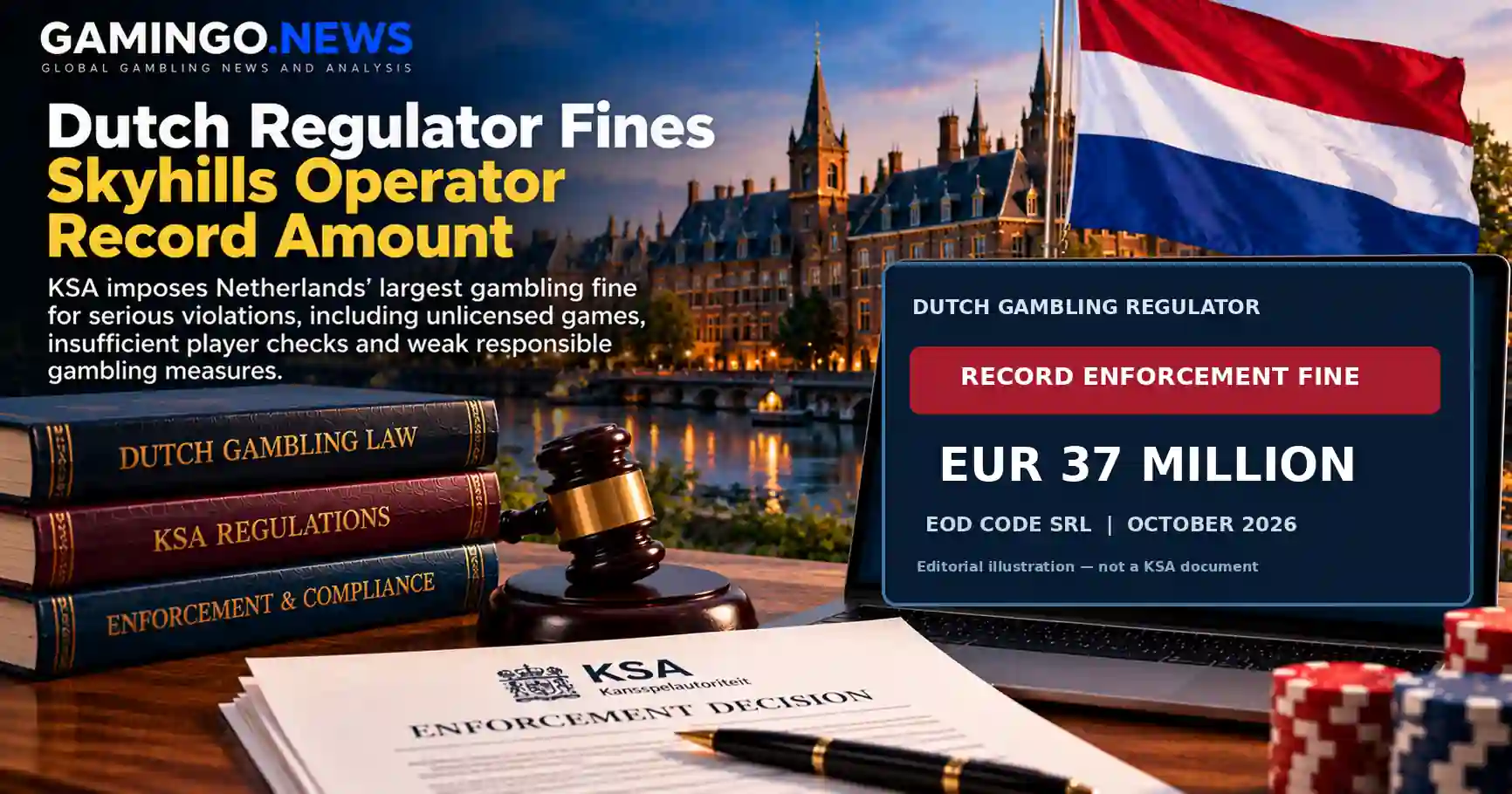
The Dutch gambling regulator has imposed its largest-ever fine for illegal gambling: about €37 million on EOD Code SRL, the company behind Instantcasino, SkyHills and ten other online casinos. The Kansspelautoriteit (KSA) announced the fine on 22 October 2026, saying Dutch players could sign up and gamble on the sites with nothing to stop them.
EOD Code, formerly Atlantis Interactive SRL, is registered in Costa Rica and has no Dutch license. Under article 1 of the Betting and Gaming Act (Wet op de kansspelen), only licensed providers may offer games of chance to people in the Netherlands.
The KSA's findings
| Finding | Detail |
|---|---|
| Sites | Instantcasino plus 11 more: skyhills.com, slotmonster.com, betiro.com, betblast.com, fastslots.com, goldenpanda.com, sambaslots.com, winningz.com, incognitocasino.com, foxygold.com, luckypays.io |
| Access from the Netherlands | No measures blocked Dutch players; KSA staff registered and gambled |
| Age verification | None visible |
| Payments | Cryptocurrency and anonymous payment methods, which the KSA says facilitate money laundering |
| Fine | About €37 million, turnover-based; the KSA's highest for illegal gambling so far |
The investigation began with Instantcasino and widened as the KSA linked the same company to eleven other brands. The fine therefore covers the company's whole offer to Dutch players, not one site.
Why €37 million
The KSA's ordinary fine policy, introduced in 2025, sorts violations into categories with fines of up to €2 million. Earlier fines for illegal offers stayed well within that range: €1.2 million for Techno Offshore, €1.05 million for Alimaniere and €900,000 for Sarah Eternal, the company behind Casinosky.
The law also lets the KSA base a fine on turnover when the standard amounts would not reflect what an illegal operator earns. The regulator estimated that EOD Code made more from Dutch players' stakes than a standard fine would capture, and set the fine accordingly. Some legal reporting gives the exact figure in the decision as about €37.25 million; the KSA's announcement rounds it to €37 million.
An order the company ignored
This is not the KSA's first move against EOD Code. On 29 July 2025 it ordered the company to stop offering games to Dutch players through instantcasino.com within four weeks, or pay €280,000 a week, up to €840,000. The KSA had found that the site was clearly aimed at the Dutch market: the Netherlands was preselected at registration, the +31 dialing code and euro were defaults, support was available in Dutch, and Bitcoin deposits were accepted.
The deadline passed on 26 August 2025. Inspections on 5, 12 and 19 September found existing customers could still log in and play. On 11 December 2025 the KSA decided to collect the full €840,000. The company did not object to the order or respond to the collection decision.
The KSA has used weekly penalty orders against other offshore sites too, including Gamusoft and Chestoption, both facing €280,000 a week, and Starscream. The EOD Code case shows its limits against an operator that does not respond, and why the KSA has now reached for a turnover-based fine.
Fines are only part of the strategy
The KSA's announcement does not say whether the fine has been paid, and collecting from a company registered in Costa Rica may be hard. The regulator says it therefore also works closely with payment service providers, hosting companies, banks and large tech companies to cut illegal offers off from Dutch players.
That follows the approach set out when the KSA declared war on illegal gambling and launched Regulator 2.0, and its chair Michel Groothuizen's call for a cross-border "gambling Interpol". European regulators have also joined forces against illegal online gambling.
SkyHills was already under pressure
On 1 September 2026, the state lottery operator Nederlandse Loterij sent a formal summons to the operators and directors of SkyHills, demanding that they stop targeting Dutch players, accept liability and disclose the structure behind the site. Chief executive Arjan Blok said SkyHills used deceptive advertising, including on TikTok, to reach young people, who could "gamble there completely unprotected." SkyHills became inaccessible in the Netherlands shortly afterward.
SkyHills was the lottery's third target of the year, after Qbet and Lalabet, against which it largely won in court in June 2026. One site going dark does not mean the rest of the network has: the KSA's decision covers all twelve domains.
What affiliates, hosts and payment firms should check
The KSA's focus on infrastructure means risk for businesses that serve offshore casinos. Influencers have already been sanctioned for promotion, as in the LeftlanePapi case. Five questions for partners:
- License: which entity holds a Dutch license, and is it the one being promoted or serviced?
- Domains: do the brands and landing pages appear in the KSA's license register?
- Geo-blocking: are Dutch visitors actually blocked, or only shown a disclaimer?
- Payments and hosting: could services be cut off by enforcement action against a client?
- Advertising records: can you show where campaigns ran and who they targeted?
Why it matters for the Dutch market
The Netherlands opened its licensed online market in October 2021 under the Remote Gambling Act (Wet Koa) to bring players to supervised operators. Licensed operators carry costs offshore sites avoid, from deposit limits to affordability checks, and the industry warns that black market play is rising across Europe, where it is now estimated at €91.6 billion.
The EOD Code fine sends two signals: the KSA will scale fines to estimated Dutch revenue, and it will go after the payment, hosting and marketing channels that keep illegal sites running.
What happens next
The company can challenge the decision through the Dutch administrative process. Whether the fine is paid, whether the remaining sites block Dutch players, and whether any appeal follows are all open. A foreign registration does not create access to the Dutch market.
Status reviewed on 23 October 2026. Findings are the KSA's; no response from the company has been published. More regulation news and EMEA coverage.
Frequently asked questions
How big is the KSA's fine on the SkyHills operator?
About €37 million, imposed on EOD Code SRL on 22 October 2026. The KSA says it is the highest fine it has imposed for illegal gambling so far. Some legal reporting puts the exact figure in the decision at about €37.25 million.
Which websites does EOD Code SRL operate according to the KSA?
Instantcasino, where the investigation began, plus skyhills.com, slotmonster.com, betiro.com, betblast.com, fastslots.com, goldenpanda.com, sambaslots.com, winningz.com, incognitocasino.com, foxygold.com and luckypays.io.
Why was the fine so much higher than earlier KSA fines?
The KSA's standard fine categories run up to €2 million, but it can calculate a fine based on turnover when the standard amounts do not reflect the revenue an illegal offer generates. It estimated that EOD Code earned more from Dutch players than a standard fine would cover, so it imposed a turnover-based fine.
Had the KSA acted against EOD Code before?
Yes. On 29 July 2025 it ordered the company, then targeting Dutch players through instantcasino.com, to stop within four weeks or pay €280,000 a week, up to €840,000. Inspections in September 2025 found the offer still accessible, and on 11 December 2025 the KSA decided to collect the full €840,000 in forfeited penalties.
Has the €37 million been paid?
There is no public indication that it has. The KSA announced that the fine was imposed; collection from a company registered abroad can be difficult, which is why the regulator also works with payment providers, hosts, banks and tech platforms to cut off illegal offers.
Is a foreign gambling license enough to serve Dutch players?
No. Under article 1 of the Betting and Gaming Act (Wet op de kansspelen), only providers licensed in the Netherlands may offer games of chance to Dutch players. A license from another jurisdiction does not count.