Ksa Market Scan: Dutch Licensed Gambling Revenue Falls to €4.1 Billion in 2025 as Online Casino and Betting Shrink
The Ksa says Dutch licensed gambling revenue fell from €4.5 billion to €4.1 billion in 2025, led by drops of 18.2% in online casino and 30.2% in online betting.
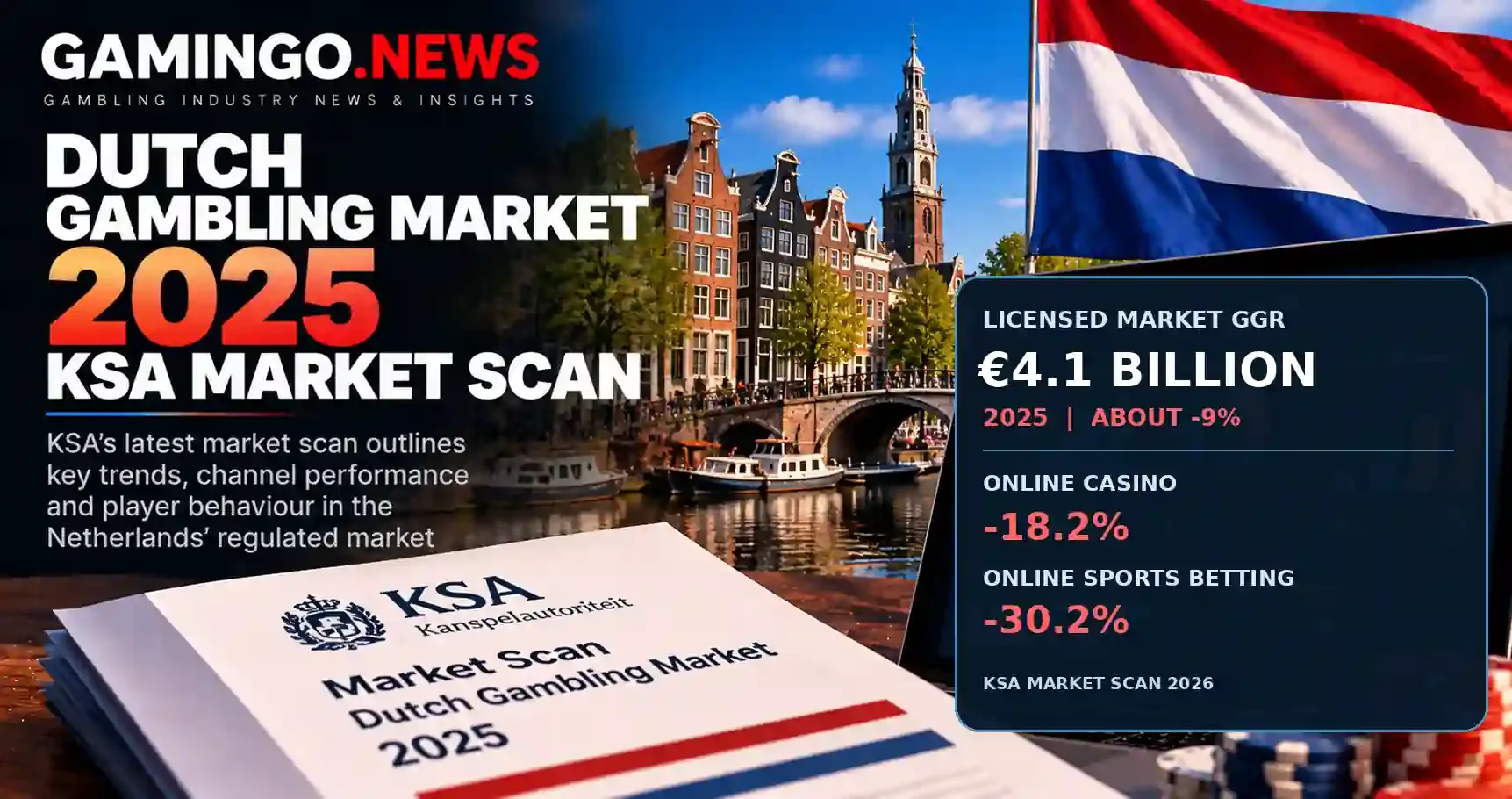
The Netherlands Gaming Authority (Kansspelautoriteit, Ksa) said on 29 October 2026 that the Dutch licensed gambling market shrank from €4.5 billion in 2024 to €4.1 billion in 2025, a fall of about 9%, as online casino revenue dropped 18.2% and online sports betting 30.2%. The figures come from the regulator's annual market scan and its latest half-yearly monitoring report, which also covers the first six months of 2026.
The Ksa measures the market in gross gaming revenue (GGR, which it calls bruto spelresultaat): money staked minus prizes paid. The 2024 comparison figure is adjusted for inflation.
Where the money fell
Online gambling did almost all of the damage. Licensed land-based gambling was roughly flat, with Holland Casino, the state-owned casino chain, posting growth.
| Segment | 2025 GGR | Change vs 2024 |
|---|---|---|
| Online casino | about €947 million | -18.2% |
| Online sports betting | about €254 million | -30.2% |
| Holland Casino | about €683 million | +2.8% |
| Arcade and hospitality machines | n/a | -4.7% |
| Lotteries | n/a | about -1.8% |
| Land-based betting | n/a | +8.5% |
| Total licensed market | €4.1 billion | about -9% |
Euro amounts for individual segments and the land-based betting figure are as reported by CasinoBeats; the percentages for the main segments match the Ksa's figures as reported by Gaming.net and InterGame. Taken together, online casino and online betting brought in about €1.2 billion, roughly a fifth less than a year earlier. Holland Casino's growth came mainly from slot machines rather than table games.
Why the Ksa says revenue fell
The regulator points to three causes. The first is the duty of care package that took effect on 1 October 2024, which Gamingo covered when the Ksa set out the new gambling rules effective 1 October. It requires operators to contact players and check affordability once net deposits pass set monthly thresholds. Early monitoring showed the effect quickly: the Ksa reported lower player losses and fewer high deposit limits within three months.
The second is tax. The Dutch gambling tax rate rose from 30.5% to 34.2% in 2025, and to 37.8% from 2026, a rise operators had warned would hurt the legal market when it was first proposed. CasinoBeats reports gambling tax receipts of about €1.05 billion for 2025.
The third is the sporting calendar. The men's European football championship in 2024 lifted betting that year, so 2025 compares against an unusually strong base.
First half of 2026: a partial recovery online
Licensed online GGR reached about €670 million in the first six months of 2026, about 11% more than in the second half of 2025, according to CasinoBeats. The Ksa suggests the men's World Cup, which started in June, contributed.
| Online indicator | H2 2025 | H1 2026 |
|---|---|---|
| Active online accounts | 1.38 million | 1.48 million |
| People gambling online per month | n/a | about 490,000 |
| People gambling online at any point in the half-year | n/a | about 820,000 |
| Licensed share of online GGR (channelization by money) | 54% | 59% |
| Online gamblers using only licensed sites | about 94% | about 94% |
More accounts do not mean more players. The Ksa estimates that the number of people who gamble online has not increased significantly, and it suggests some players open accounts with several licensed operators to get around deposit limits that apply per account. That is a regulatory point as much as a commercial one: limits designed per account lose force when players spread their play.
The illegal market gap
Channelization, the share of gambling that stays with licensed operators, looks very different depending on how it is counted. About 94% of people who gamble online use only legal sites, a figure the Ksa says has stabilized. But licensed operators took only 59% of online GGR in the first half of 2026. The Ksa's reading is that people who gamble with illegal operators lose considerably more on average than those who stay licensed.
The illegal share by money has been a concern since data in 2025 showed unlicensed spending nearly matching the legal market. The Ksa has stepped up enforcement in response, including its record €37 million fine on EOD Code, the operator of SkyHills and Instantcasino, on 22 October 2026.
Gambling harm indicators
The report's harm data is mixed. More than 14% more people entered treatment for gambling addiction in 2025 than in 2024, based on a separate national care information system. Survey data from Ipsos for 2026 shows the high-risk group unchanged, the moderate-risk group smaller and the low-risk group larger. Ipsos estimates that 65% of people who gamble online do so without problems, the same as in 2025.
What it means
The market scan shows the trade-off Dutch policy makers now face. Stricter duty of care rules and a higher tax have cut licensed online revenue sharply, while the money share going to illegal sites remains large. The figures are likely to feed the debate over deposit limits and the tax rate. The regulator is also running a separate tender for the Dutch horse racing totalisator monopoly, which opens in January 2027. Gamingo's earlier look at the Dutch online market nearing its peak in 2023 shows how quickly the trend has turned.
Status reviewed on 30 October 2026. Figures are from the Ksa's market scan and monitoring report as reported by Gaming.net, InterGame and CasinoBeats; segment euro amounts are from CasinoBeats, and the Ksa publication itself could not be accessed for this story. More regulation news and EMEA coverage.
Frequently asked questions
How big was the Dutch gambling market in 2025?
The Netherlands Gaming Authority (Ksa) puts licensed gross gaming revenue, meaning stakes minus prizes, at €4.1 billion for 2025. That is down from €4.5 billion in 2024 on an inflation-adjusted basis. Most of the fall came from online casino and online sports betting, while Holland Casino and land-based betting grew slightly. The figures cover licensed operators only and exclude the illegal market.
Why did Dutch online gambling revenue fall in 2025?
The Ksa gives three main reasons. Duty of care rules that took effect on 1 October 2024, including net deposit limits that force operators to check affordability, cut how much players lose. The gambling tax rate rose to 34.2% in 2025. And 2024 had the men's European football championship, which inflated sports betting that year, so betting revenue fell back sharply in 2025.
What share of Dutch gambling goes to illegal sites?
By players, about 94% of Dutch online gamblers use only licensed sites, according to the Ksa. By money, the picture is different: licensed operators took about 59% of online gross gaming revenue in the first half of 2026, up from 54% in the second half of 2025. The Ksa reads the gap as a sign that people who gamble illegally lose considerably more on average.
Why are there more Dutch gambling accounts but not more gamblers?
Active online accounts rose to 1.48 million in the first half of 2026, from 1.38 million six months earlier, yet the Ksa estimates only about 490,000 people gamble online in a typical month. It suggests the men's World Cup, which began in June 2026, played a part, and that some players open accounts with several operators to get around deposit limits that apply per account.
What is the Kansspelautoriteit?
The Kansspelautoriteit (Ksa), or Netherlands Gaming Authority, is the Dutch gambling regulator. It licenses and supervises operators under the Betting and Gaming Act, including the online market that opened under the Remote Gambling Act in October 2021. It sets duty of care rules, publishes market and monitoring reports, and fines illegal operators that target Dutch players.