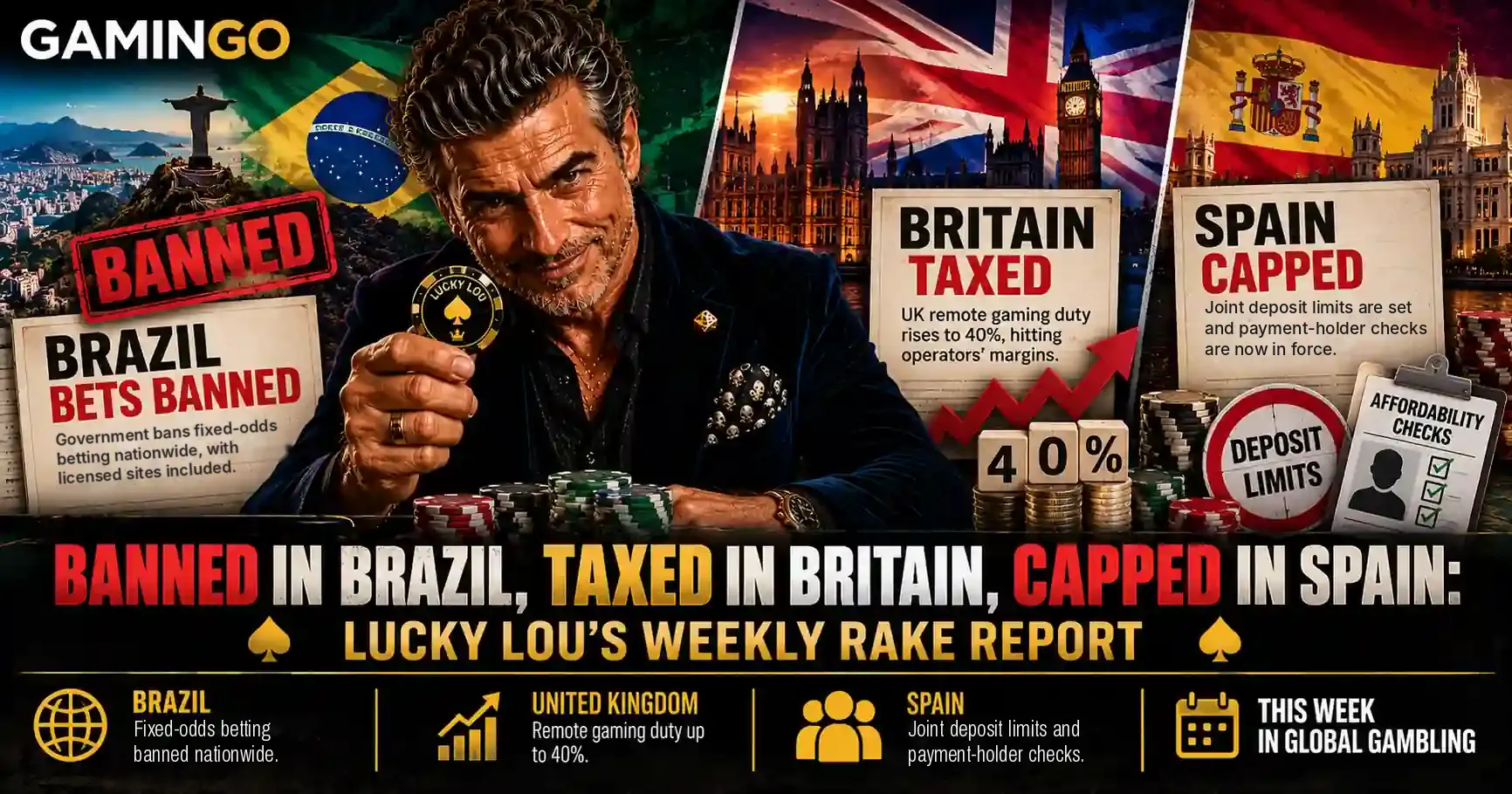
Banned in Brazil, Taxed in Britain, Capped in Spain: Lucky Lou's Weekly Rake Report
Lucky Lou on a week of bans, taxes and caps: Brazil's betting shutdown, Britain's 25% machine duty, the KSA's record €37m fine and Spain's deposit leash.
Pull up a stool, degenerates. Lucky Lou just read a week of iGaming headlines in one sitting, and I need a stiff drink, a lie-down, and a government-free zone to place a bet in.
Here's the box score. One country switched off an entire industry and is now waiting for a judge to say whether that was allowed. One chancellor "went easy" by raising the rake only to 25%, and expects applause. One regulator fined a casino network a record €37 million for the crime of not bothering to hide. And one ministry is building a deposit leash that follows you from operator to operator like an ex who knows all your passwords.
Seven days. Four regulators. Zero mercy. Let's walk the felt.
Brazil: the great switch-off
Brazil signed Provisional Measure 1,394 on 25 September, and it does not do nuance. It bans the operation, offer, intermediation and advertising of fixed-odds betting nationwide, foreign operators included. Platforms were ordered offline from 6 October.
Then, on 25 October, Lula won a fourth term, 51.79% to 48.21%. According to Casinos.com, the sector had expected the other guy to win and had been negotiating with his people about softening the measure. That's the worst kind of bad beat: you read the board perfectly, then the river killed you. A 4.4-million-vote margin is still closer than most of my parlays. The runoff itself had a betting subplot, which we covered in Brazil's betting ban and the presidential runoff.
The damage tally, per iGaming Business estimates rather than official data: about BRL1.2 billion in operator revenue gone and more than BRL400 million in tax the government will never see. Licensed operators paid BRL30 million for five-year concessions and got roughly twenty-one months of use. That's a lousy return, even by my standards.
Now the sequel. Justice Luiz Fux has called a Supreme Court public hearing for 3 November with 26 participants, including the Finance Ministry, the broadcasters, and ten football clubs, Flamengo and Corinthians among them. No injunction yet. Congress has until 23 November to vote. The only thing moving slower than a legislature is the cashier line on payday.
Britain: the 25% "mercy" raise
Chancellor John Healey delivered the Budget on 28 October and, with a straight face, raised Machine Games Duty from 20% to 25% on higher-stake machines from April 2027. That covers machines with a stake above £1 or a prize above £100.
The industry had braced for 40%. Entain warned that another hike could add about £100 million a year to its retail costs, and figures commissioned by the BGC from EY put the damage at up to 1,470 betting shop closures. So 25% counts as relief. This is the taxman's oldest trick: scare you with a 40% horror story, hit you for 25%, and let you thank him.
Betting and Gaming Council CEO Grainne Hurst called it "a deeply damaging decision." The BGC, citing EY, says even 25% could cost almost 9,000 jobs and put nearly 1,000 shops and casinos at risk. These are the lobby's numbers, so season to taste, but the direction is hard to argue with.
Look at Evoke, the William Hill owner. Q3 revenue fell 7% to £406 million, with about 270 shops closed in a year. Strip out the closures and revenue is down only 2% at constant currency. The CEO tied the shutters to higher gaming duties. Remote Gaming Duty went from 21% to 40% in April, and a 25% remote betting duty arrives next April. Britain's plan to fix the high street is to tax it into a car park.
Europe's leash: Dutch fines and Spanish limits
The Dutch regulator, the KSA, fined EOD Code SRL €37 million, the biggest illegal-gambling penalty it has ever issued. The network ran 12 casino brands starting with Instant Casino. The KSA says its own staff gambled on the sites from the Netherlands with no blocking at all, saw no visible age verification on several, and found crypto and anonymous payments on offer. The company behind them is registered in Costa Rica. When the evidence collects itself, the regulator just sits down and cashes out.
Spain went the other way and built the leash. From late March 2027, a joint limit across all licensed operators caps you at €700 a day, €1,750 a week and €3,300 per four weeks. The ministry estimates that about a third of active players use more than one operator, which is exactly who this is aimed at.
And since 28 October, Royal Decree 813/2026 requires your payment method to belong to you. New accounts must comply immediately. Existing ones get six months, during which you can deposit and play but cannot withdraw winnings until verified. Miss the deadline and the account closes, with your balance refunded. The ministry cites a 12% rise in impersonation reports in 2025, which is a fair reason, but "you may play, you may not cash out" is how a casino cage would run if the cage were a ministry.
Meanwhile, Michigan prints money and Bucharest reshuffles
Not every market is on fire. Michigan's September online revenue hit $355.7 million, with $300.2 million from iGaming, per the Michigan Gaming Control Board. When governments want to see how a regulated market works, they should look there.
Back home in Romania, President Nicușor Dan designated Luca Niculescu as prime minister on 5 October, and Parliament approved his government on 20 October with 280 votes. ONJN is still settling in under Valentin-Ioan Tomescu, who took over after Vlad-Cristian Soare's exit in August. Meanwhile the winnings tax still runs 4%, 20% and 40% by tier. Stability is the rarest chip in this casino, and nobody's selling. If you're sizing up the Romanian table anyway, the Romania B2C licence guide shows what it takes to sit down.
The house always reshuffles
So that's the week: a nation that pulled the plug, a Treasury that rounded up the rake, a regulator that fined a dozen casinos for forgetting to wear a mask, and a ministry that wants to meter your fun.
They'll cap it, tax it, ban it and fine it, and they'll call every move "protection." But the pattern holds from São Paulo to Nicosia: squeeze the legal table and the crowd moves to a darker one. Brazil is about to run that experiment live.
Me? I'll be right here, cold streak and all, watching the next ruling land. Deal me in.
— Lucky Lou
Status reviewed on 31 October 2026. Revenue and tax-loss figures for Brazil are iGaming Business estimates; job and closure figures for the UK are industry numbers attributed to the BGC, EY and Entain. More from Lucky Lou, regulation news and EMEA coverage.
Frequently asked questions
Is sports betting still banned in Brazil?
Yes, as of 31 October 2026. Provisional Measure 1,394 of 25 September bans the operation, offer, intermediation and advertising of fixed-odds betting, and platforms had to go offline from 6 October. The Supreme Court (STF) holds a public hearing on 3 November, no injunction has been granted, and Congress has until 23 November to vote on the measure.
What did the UK Budget change for gambling on 28 October 2026?
It raised Machine Games Duty from 20% to 25% on machines with a stake above £1 or a prize above £100, from 1 April 2027. The 40% rate some had proposed was not adopted. Remote Gaming Duty already rose from 21% to 40% in April 2026, and a 25% remote betting duty starts in April 2027.
How big was the Dutch KSA fine on EOD Code?
About €37 million, the largest fine the KSA has imposed for illegal gambling. EOD Code SRL ran 12 unlicensed casino brands, starting with Instant Casino. KSA staff could register and play from the Netherlands, several sites had no visible age checks, and crypto and other anonymous payments were accepted.
What are Spain's new joint deposit limits?
Default limits of €700 a day, €1,750 a week and €3,300 per four weeks, applied across all licensed operators combined and managed centrally by the DGOJ. They take full effect in late March 2027 after a test period. Separately, Royal Decree 813/2026 has required since 28 October 2026 that the payment method belongs to the account holder.