
Digital Seals and Leaky Deals: Lucky Lou on the Breach That Sank Curaçao's Licensing Portal
Curaçao's gaming regulator says its licensing portal was accessed for nine months. More than 40,000 files were published, and the portal has been scrapped.
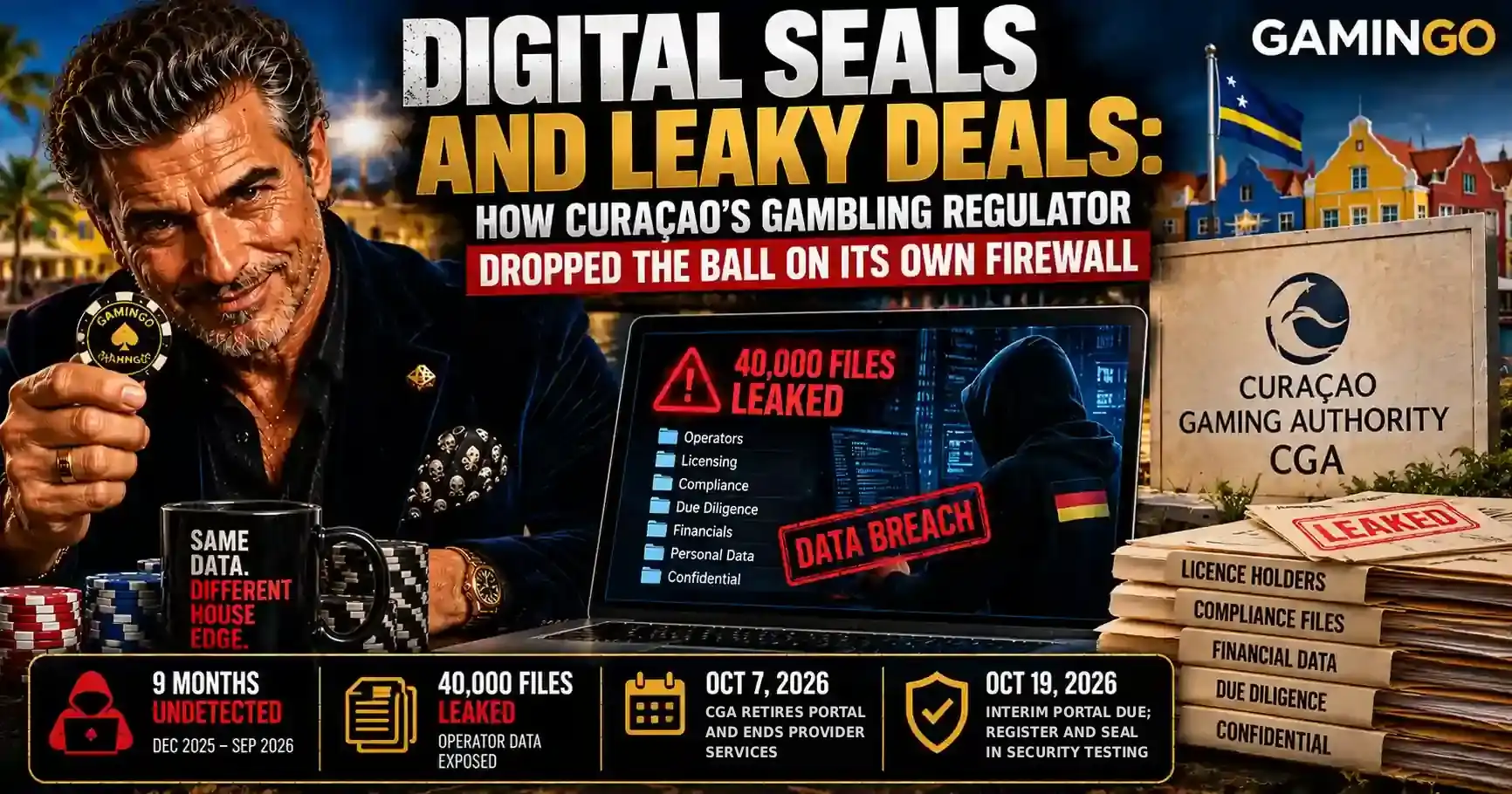
Pull up a stool, folks, because Curaçao's gambling regulator just learned the oldest lesson in the casino business: the most valuable thing in the building isn't the cash cage. It's the filing cabinet.
And for nine months, somebody else had the key.
What happened in the CGA data breach
The short, sober version first, for the people who skip to the facts:
The Curaçao Gaming Authority (CGA) says an unauthorized person accessed its externally managed online licensing portal and its database from December 2025 to September 2026, and published confidential information belonging to license holders. The CGA discovered the breach on 17 September 2026, took the portal offline, and on 7 October announced it would retire it for good. Existing licenses remain valid.
| Status | What we know (23 October 2026) |
|---|---|
| Confirmed by the CGA | Unauthorized access, December 2025 to September 2026; discovered 17 September; portal retired; provider's services ended; complaints filed in Curaçao, Germany and the Netherlands; licenses still valid |
| Reported | An archive of more than 40,000 documents, published by German hacker Lilith Wittmann |
| Scheduled | An interim portal from 19 October, with the license register and digital seal, after independent security testing |
| Unknown | How many licensees were affected; whether the leaked files are fully off the internet; when the client portal returns |
Nine months at the table, and nobody checked the cameras
The CGA calls it what it is: "criminal conduct by a person who accessed the portal without authorization and took information from it." It says a digital security researcher from Germany got in back in December 2025. The regulator only spotted it in September 2026.
Nine months. In casino terms, that's a guy sitting at your blackjack table counting cards since Christmas while the pit boss admires the carpet.
The portal wasn't run in-house. The CGA says an external company managed both the portal and its database. On 7 October it announced it would stop using the platform and end that provider's regulatory services permanently. The provider hasn't been officially named, and Lou isn't going to guess.
40,000 files and a searchable database
Here's where the house gets embarrassed. In September, Lilith Wittmann, the German hacker and activist who earlier this year said she had breached the Malta Gaming Authority's systems, published what reporting describes as more than 40,000 documents from the Curaçao portal.
According to Casino.org, the archive includes thousands of license application files: ultimate beneficial owner details, corporate structures, source-of-wealth and funding documents, business plans, due-diligence material, and the CGA's own internal reviews and license conditions. It went up as a searchable database. When its first domain was put on hold, it reappeared somewhere else within hours.
The CGA hasn't confirmed the 40,000 figure, and Lou won't pretend it has. The regulator says it has hired specialist firms to scrub the material from the internet and commissioned an independent forensic investigation. It has filed complaints with authorities in Curaçao, Germany and the Netherlands and is considering civil action. No charges have been reported.
Wittmann, for her part, is no stranger to a courtroom: in September a Berlin court largely sided with her against the MGA, allowing her to keep using the Malta material while barring her from accessing the MGA's systems again.
Lou's read: whatever you think of the person who walked in, the door was open for nine months.
Why the digital seal matters
Every Curaçao-licensed casino carries a little clickable badge in its footer. Click it, and it's supposed to take you to the CGA's record showing which company holds the license and which domains it covers. It's the closest thing offshore players have to a certificate on the wall.
When the portal went dark, the seal went wobbly with it. The CGA warned on 7 October that the seal would be affected and promised a new way for operators to prove their domains are licensed.
So, players, until the new system is proven:
- Find the company name and license number in the casino's footer or terms.
- Check the CGA's public license register, and look for the exact domain, not just the company.
- Click the seal. A dead seal right now isn't proof of a rogue site; a seal pointing somewhere other than the regulator's own domain is a red flag.
- If in doubt, wait. Don't deposit at a new site until you can confirm its license independently.
The biggest challenge here isn't restoring a badge in a casino footer. It's restoring confidence in the systems behind that badge.
The stopgap portal
The CGA says it is building a new portal that it will run itself. In the meantime, an interim system was scheduled for 19 October. The regulator said the internal system, the digital seal and the license register were ready for independent security checks, while the client portal, where licensees actually submit things, still needed adjustments before testing.
Read that carefully: scheduled, ready for testing, still being adjusted. As of this writing, nobody has publicly confirmed that every piece is up and running. Lou will believe the seal works when he clicks it.
The CGA also says it has hired 14 staff in licensing, supervision and enforcement since the reform began, to rely less on outside advisers. After this hand, that looks like the smartest bet on the table.
What the shutdown means for LOK applicants and licensees
Curaçao's new gambling law, the LOK, took effect in December 2024 and killed the old master-license racket, replacing it with direct CGA licensing and supervision. The whole pitch was: real regulator, real oversight, real records. We tracked every step, from the final stages of the reform through implementation and Dutch cooperation to the AML/CFT policy deadline and the CGA's push against operators without Curaçao licenses.
The irony stings. The LOK made applicants hand over more sensitive paperwork than ever, from UBO files to source-of-wealth evidence, and that's exactly what ended up in a public database.
For operators, the practical hand looks like this:
- Your license is still valid, and every obligation still applies. The CGA says closing the portal changes neither.
- Assume your file may be out there. Review what you submitted, warn affected directors and shareholders, and watch for phishing and impersonation that uses the leaked details.
- Check your data protection duties. If the leak included personal data you collected from staff or owners, your own obligations to those people don't vanish because the regulator was the one breached.
- Expect delays. Submissions run through a portal that is still being fixed.
- Keep your options open. Some operators will now look again at other jurisdictions; our complete guide to iGaming licenses compares the field, from Anjouan and Nevis to Tobique and Kahnawake, and Szilaghi Consulting's comparison of 25 licensing jurisdictions sets out current fees and timelines. For Curaçao itself, see what the CGA license costs under the LOK.
Lou's take
Regulators love to fine operators for sloppy data protection. Sweden's regulator once had to deny a leak of its own self-exclusion data. Now Curaçao has the bad beat, and on the worst possible card: the files it demanded in the name of doing things properly.
To its credit, the CGA has done the right things since the discovery: pulled the system, cut the provider, called the authorities, hired forensics and told licensees their licenses stand. But nine months of undetected access is a long time, and trust, like a bankroll, is a lot easier to lose than to rebuild.
What happens next
- The interim portal: whether the register, seal and client portal pass security testing and actually work.
- The forensic report: how the breach happened, and how many licensees and individuals were affected.
- The complaints in three countries, and any civil claim.
- The new in-house portal, with no date yet.
Curaçao has spent two years trying to prove it's a real regulator, not a rubber stamp. This is the hand that tests it. Lou will be watching the cards.
Status reviewed on 23 October 2026. "Confirmed" means stated by the CGA; "reported" means attributed to media reporting. More regulation news, Latin America and Caribbean coverage and Lucky Lou's columns.
Frequently asked questions
What happened to the Curaçao Gaming Authority's licensing portal?
The CGA says an unauthorized person accessed its externally managed online licensing portal and database between December 2025 and September 2026 and published confidential licensee information. It discovered the incident on 17 September 2026, took the portal offline and, on 7 October, announced that it would permanently retire it and end the external provider's services.
How many files were leaked from the CGA portal?
Reporting describes an archive of more than 40,000 documents, published in September 2026 by a German security researcher identified as Lilith Wittmann. The CGA has not publicly confirmed that number.
Are Curaçao gambling licenses still valid after the breach?
Yes. The CGA says closing the old portal does not invalidate existing licenses, and licensees remain subject to all their obligations and to supervision.
Was the new CGA portal working on 19 October 2026?
The CGA scheduled an interim portal for 19 October 2026. It said the internal system, digital seal and license register were ready for independent security checks, while the client portal still needed adjustments before testing. Public reporting at the time did not confirm that every component was live.
What is the Curaçao digital seal?
It is a clickable badge on a licensed website that leads to the CGA's record of that domain, so visitors can check whether the site is covered by a Curaçao license. The CGA has said the old seal would be affected by the portal shutdown and is introducing a new mechanism.
What is the LOK?
The National Ordinance on Games of Chance (Landsverordening op de Kansspelen) took effect in December 2024. It replaced Curaçao's old master license and sub-license system with direct licensing and supervision by the CGA.
- Curacao
- Curaçao Gaming Authority
- CGA
- LOK
- Data Breach
- Cybersecurity
- Gambling Licensing
- Digital Seal
- Lucky Lou
- Gambling Regulation


