
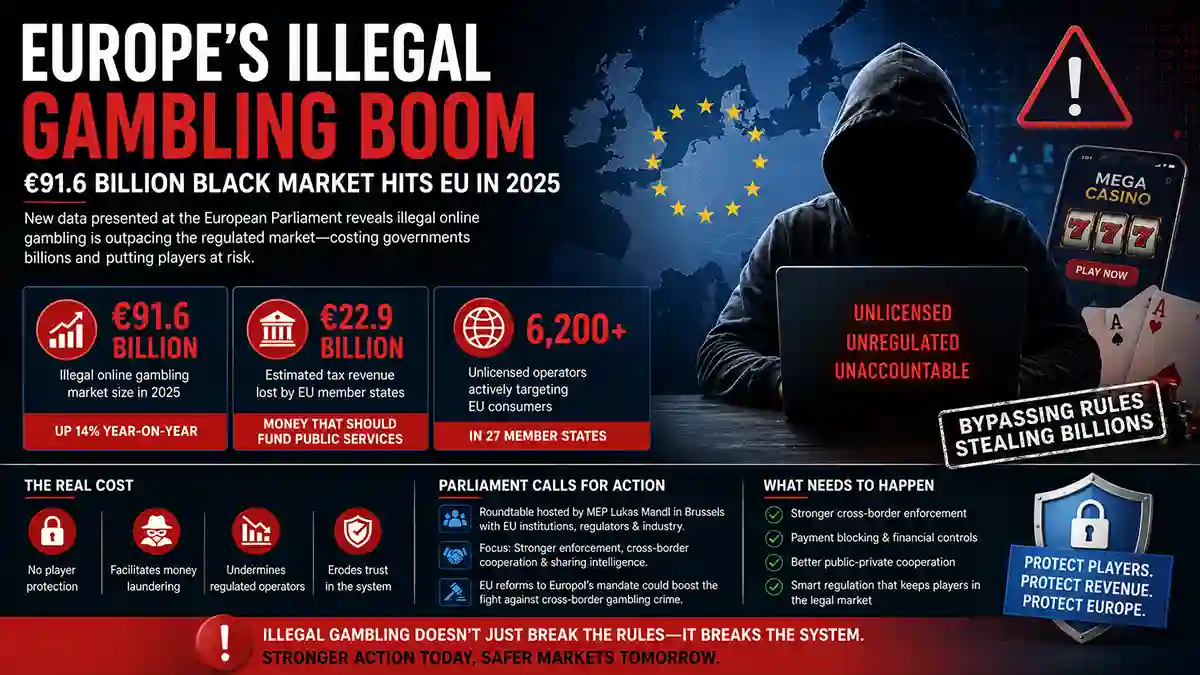
Europe's regulated gambling industry has a problem it can no longer ignore. According to new industry figures, illegal online gambling generated €91.6 billion in 2025—enough to eclipse much of the regulated market.
For years, regulators focused on licensing, compliance, and responsible gambling. Meanwhile, thousands of offshore operators quietly built businesses beyond European oversight. The result is a market where unlicensed casinos and sportsbooks attract millions of players while contributing nothing to public finances or consumer protection.
Whether you're an operator, affiliate, regulator, or serious gambling industry observer, understanding the scale of Europe's black market is essential. This isn't simply about lost tax revenue. It's about player safety, regulatory credibility, and whether licensed businesses can realistically compete against companies that ignore the rules.
Here's why illegal gambling continues to expand, why enforcement is struggling to keep pace, and what Europe must do before the regulated market loses even more ground.
What You'll Learn
- Why Europe's illegal gambling market keeps expanding.
- How much tax revenue EU governments are losing.
- Why licensed operators struggle against offshore competitors.
- What regulators may need to change to reverse the trend.
Europe's Illegal Gambling Market Is No Longer a Side Problem—It's Becoming the Main Market
The European gambling industry has spent years building regulated markets designed to protect players while generating tax revenue.
Yet one uncomfortable fact continues to undermine that effort.
Illegal operators are growing faster than many licensed businesses.
According to figures presented by the European Casino Association (ECA) during a roundtable at the European Parliament, illegal online gambling targeting EU consumers generated €91.6 billion in gross gaming revenue during 2025.
The financial consequences are enormous.
The ECA estimates that EU member states collectively lost €22.9 billion in tax revenue as players migrated toward unlicensed platforms.
Those numbers should concern everyone involved in regulated gambling.
This Is No Longer a Small Black Market
Illegal gambling was once viewed as a niche issue.
That description no longer fits.
Research conducted by Gambling Compliance International suggests that more than 6,200 unlicensed gambling websites actively target customers across the European Union.
These operators don't simply exist in hidden corners of the internet.
Many advertise aggressively through social media, streaming platforms, influencer marketing, search engines, messaging apps, and affiliate websites.
Some even offer customer support in multiple European languages.
The sophistication of these businesses continues to increase.
Why Players Leave Licensed Casinos
The industry often presents illegal gambling as purely a criminal problem.
Reality is more complicated.
Players usually don't wake up intending to gamble illegally.
They leave regulated platforms because offshore sites often offer something licensed operators cannot.
Higher betting limits.
Larger bonuses.
Fewer verification checks.
Faster registration.
Crypto payments.
Minimal affordability controls.
No deposit restrictions.
No source-of-funds questions.
These features obviously carry serious risks.
However, they also create a more convenient customer experience.
This is precisely why enforcement alone rarely solves the problem.
If regulated gambling becomes too restrictive, many players simply move elsewhere.
Regulation Without Balance Can Backfire
Responsible gambling remains essential.
Nobody seriously disputes that.
However, regulators face a difficult balancing act.
Every new restriction placed on licensed operators increases the competitive advantage enjoyed by companies operating completely outside the legal framework.
That's one reason channelisation—the percentage of players using licensed operators—has become one of the industry's most important performance indicators.
High channelisation means regulation is working.
Low channelisation means players are voting with their wallets.
Several European markets are now seeing warning signs.
The black market continues expanding despite stronger enforcement.
That should encourage policymakers to ask a difficult question.
Are current regulations reducing gambling harm—or simply pushing customers toward operators with no safeguards at all?
Brussels Is Paying Attention
The issue recently reached the European Parliament.
A roundtable hosted by Member of the European Parliament Lukas Mandl brought together representatives from:
- The European Commission
- Europol
- Eurojust
- The Anti-Money Laundering Authority (AMLA)
- National gambling regulators
- Industry representatives
The discussion focused on strengthening cross-border enforcement.
That's becoming increasingly important because illegal gambling networks rarely operate from the same country as their customers.
One operator may hold a license in a distant jurisdiction while accepting players across dozens of European countries simultaneously.
National regulators cannot tackle that challenge alone.
Player Protection Disappears Outside Regulation
One fact deserves repeating.
Illegal gambling sites aren't merely unlicensed.
They are largely unaccountable.
Many provide no independent game testing.
Complaint procedures are often nonexistent.
Responsible gambling tools may be absent or purely cosmetic.
Self-excluded players frequently regain access using another account.
Disputes over winnings rarely receive impartial review.
When problems occur, players have almost no legal protection.
That's exactly why regulated gambling exists.
Unfortunately, those protections only matter if players remain inside the licensed market.
Money Laundering Remains a Serious Concern
The ECA also linked illegal gambling to broader financial crime.
Licensed operators invest heavily in:
- Know Your Customer (KYC) procedures
- Anti-money laundering monitoring
- Transaction reporting
- Identity verification
- Suspicious activity detection
Illegal operators generally avoid those obligations entirely.
That creates opportunities for organized criminal groups to move funds through gambling platforms with minimal oversight.
As Europe's AML framework becomes stricter, cooperation between gambling regulators and financial intelligence agencies will become increasingly important.
Can Europe Reverse the Trend?
The answer isn't as simple as blocking websites.
Experience shows that domain blocking alone achieves limited success.
Operators simply launch new websites.
Payment blocking helps.
International cooperation helps.
Criminal investigations help.
However, enforcement alone rarely eliminates demand.
The regulated market must also remain commercially competitive.
If legal operators cannot offer attractive products while offshore competitors operate without restrictions, the black market will continue growing regardless of how many websites authorities block.
This isn't an argument against regulation.
It's an argument for smarter regulation.
Good policy protects consumers without making licensed gambling so unattractive that players leave altogether.
Finding that balance is far more difficult than passing another law.
Conclusion
Europe's €91.6 billion illegal gambling market isn't just a regulatory headache—it's evidence that enforcement alone cannot solve the problem.
Governments need stronger cross-border cooperation, faster action against criminal operators, and better financial intelligence. Just as importantly, they need regulated markets that players actually want to use.
The gambling industry has learned one lesson repeatedly over the past decade: players don't disappear when rules become stricter. They simply move elsewhere. The real challenge isn't eliminating illegal gambling. It's making the legal market the obvious choice.
📢 Join the Conversation!
Want to share your thoughts or ask questions about our latest articles? Stay connected and be part of the discussion by joining our Telegram and WhatsApp channels! 🔹 Get real-time updates 🔹 Share insights with industry peers 🔹 Ask questions & get expert answers 👉 Join us on Telegram 👉 Join us on WhatsApp Let’s keep the conversation going!
- Black market gambling
- ECA
- EU gambling
- Gambling Regulation
- illegal online gambling Europe


