
Greece has spent years blocking illegal gambling websites. It now wants to arrest the people behind them.
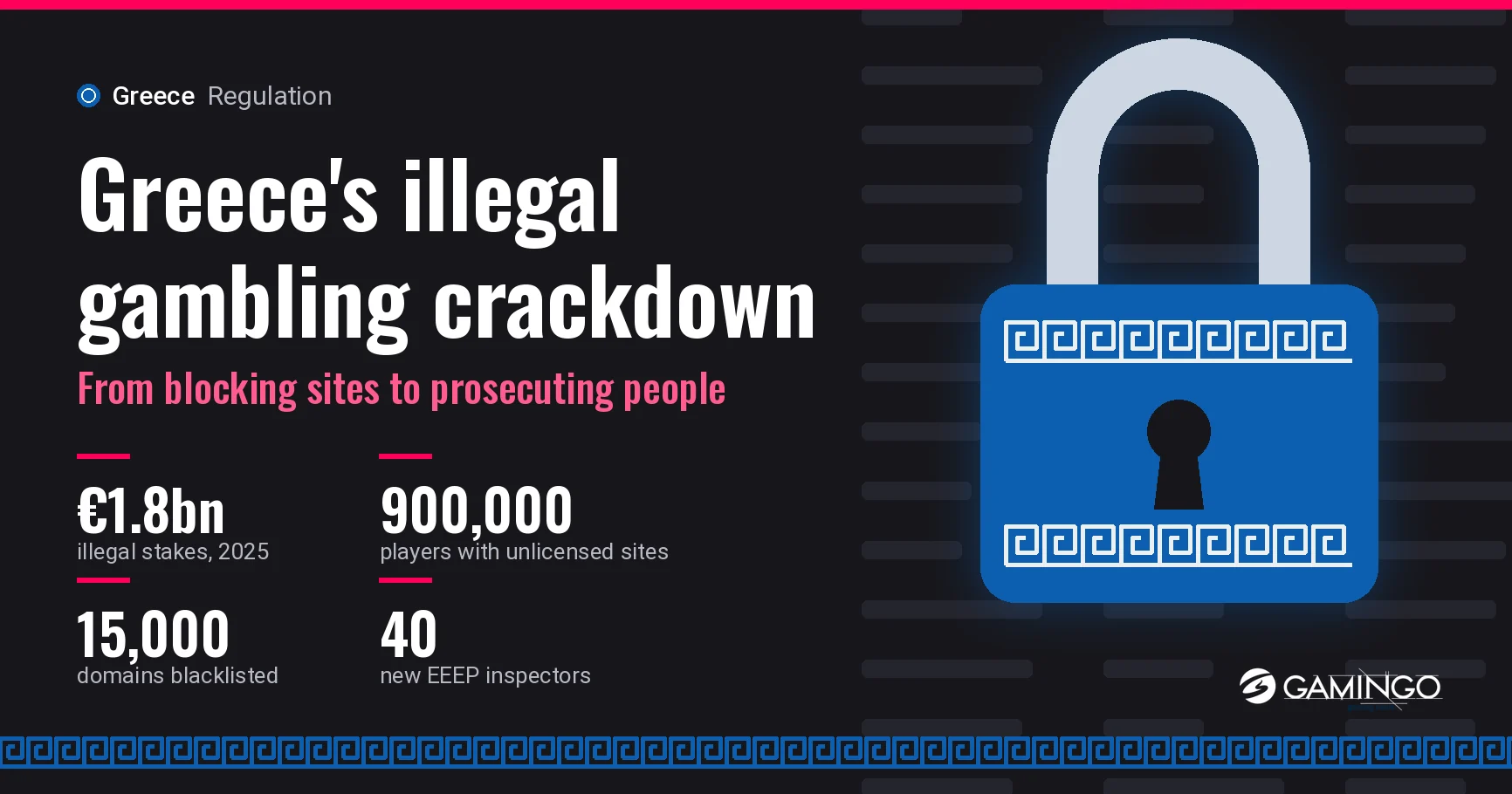
The Hellenic Gaming Commission (EEEP) is recruiting 40 staff for its inspection and enforcement work, according to Greek media reports. The posts are filled mainly by secondment from elsewhere in the public sector, and applications reportedly close on 6 November 2026. The hires are the first visible step in putting June's gambling law to work. That law turned the regulator's inspectors into criminal investigators, raised prison terms for illegal operators and wrote specific fines into statute for the influencers and affiliates who send players to unlicensed sites.
The government's own numbers explain the urgency. Blocking has not shrunk the black market: it has grown.
Greece's illegal gambling market by the numbers
| Measure | Figure | Source and date |
|---|---|---|
| Illegal stakes, 2025 | about €1.8bn | Finance Minister K. Pierrakakis, 6 Oct 2026 |
| Players with unlicensed operators, 2025 | about 900,000 | Finance Minister, 6 Oct 2026 |
| Illegal stakes and players, 2024 | €1.67bn, about 800,000 | EEEP survey cited by the minister, Jul 2025 |
| Domains on the EEEP blacklist | about 15,000 (11,000 in Dec 2025) | Finance Ministry, Oct 2026; EEEP, Dec 2025 |
| New gambling domains registered online | about 10,000 a month | EEEP, Dec 2025 |
| Legal market GGR, 2025 | €3.073bn, up 6.74% | EEEP annual report, Jul 2026 |
| Online share of legal GGR, 2025 | 38.8%, growing 11.75% a year | EEEP annual report, Jul 2026 |
| State revenue from licensed gambling, 2025 | €1.169bn, up 11.24% | EEEP annual report, Jul 2026 |
| Licensed online operators | 18 | EEEP, Oct 2026 |
One caution on reading the table: the €1.8bn is money staked, while the €3.07bn is gross gaming revenue, what operators keep after paying out winnings. The illegal market is therefore not "more than half" the legal one; on a like-for-like basis it is a good deal smaller. It is still large enough to matter, and the trend is the wrong way: stakes rose by roughly €130m and the player count by about 100,000 in a year in which the blacklist grew by around 4,000 domains.
Why blocking alone stopped working
The arithmetic is the regulator's own. At a briefing in December 2025, EEEP officials said they had blocked about 11,000 domains, and that roughly 10,000 new gambling domains appear online every month. A blacklist grows by addition; a mirror site costs minutes. Blocking through the telecoms regulator EETT and internet providers keeps unlicensed brands off page one, but it does not touch the people who run them, the agents who take cash, or the creators who post the links.
That is the gap the new law aims at. "The internet is not a jungle," Finance Minister Kyriakos Pierrakakis told the commission on 6 October, adding that a site's foreign base gives no shelter in Greece.
What Law 5313/2026 changes
The gambling reform did not arrive as a stand-alone act. It sits inside Law 5313/2026, an omnibus bill passed in June that is mostly about energy-crisis relief and incomes, with a chapter on the Gaming Supervision and Control Commission and the gaming framework. A first draft went to public consultation in February, when Gamingo reported the proposed penalties.
Investigators, not only inspectors. Members of the Gaming Inspectors Corps become special investigating officers for gambling offenses, which lets them build criminal files rather than refer cases on.
A bigger regulator. EEEP's permanent establishment rises from 80 to 110 posts: 70 administrative and 40 specialist roles covering enforcement, IT and cybersecurity, and market intelligence. The current call for 40 inspection staff runs alongside that.
New tools. Article 61 amends Article 17 of Law 3229/2004 so EEEP can contract outside services for illegal-gambling detection, mystery-shopper inspections, monitoring software, anti-money laundering checks and databases for vetting operators' beneficial owners. It also makes EEEP an instructing authority for removing illegal online content under Law 5099/2024, and requires it to send the tax authority AADE quarterly data from the central gaming server.
Heavier penalties.
| Offense | Prison | Fine |
|---|---|---|
| Running illegal games of chance | at least 10 years | €50,000 to €700,000 |
| Aggravated cases: commercial scale, minors involved, or reopening sealed premises | at least 10 years | €100,000 to €800,000 |
| Illegal non-gambling games | at least 3 years | €10,000 to €500,000 |
| Playing in unlicensed games of chance | up to 2 years | a fine; €5,000 to €20,000 for repeat offenders |
| Promoting unlicensed gambling (influencers, streamers, affiliates, ad networks, advertisers) | none | €5,000 to €50,000 per violation |
| Internet providers and other third parties | none | €1,000 to €2,000,000 per violation |
Venues where illegal gambling is found can be shut for up to a year, and municipalities can withdraw their operating licenses.
Influencers are the first test
Within four months of the law passing, the Finance Ministry filed complaints against 18 social-media personalities, including well-known rappers and models, accused of promoting unlicensed gambling to a combined following of about 3.6 million. They have not been named and the cases are at the preliminary investigation stage. "Popularity does not grant immunity," the minister said.
Greece has acted against platforms before: in 2023 it blocked the streaming platform Kick over gambling content. Other regulators have moved the same way, from Portugal, where the operators' association APAJO reported influencers and unlicensed operators to the police, to Australia, where ACMA has issued warnings to influencers. What is different in Greece is the per-violation fine written into statute and the prospect of criminal charges alongside it.
The ministry links the push to young people. A European study cited by EEEP found that one in three 16-year-olds in Greece had gambled illegally online, and the commission has made protecting minors a pillar of its 2026–2030 strategic plan.
Licensed operators are under the lens as well
The crackdown is not only aimed at the black market. In October EEEP asked all 18 licensed online operators to explain how they register, retain and reward VIP and high-value players, including bonus programs and hospitality. The stated purpose is statistical. The context suggests more: the commission is looking at closing the loophole that lets a player hold several accounts under different identities, and is considering a single national verification step through the government's e-Gov platform, after an earlier plan to verify players through the banks was dropped for lack of a legal basis.
There is a balance to strike, and EEEP's leadership has said so: heavy-handed rules on bonuses and limits in the licensed market can push the highest-spending players offshore, which is exactly the leakage the new inspectors are meant to stop.
What to watch next
- 6 November 2026: the reported closing date for the 40 inspection posts. How quickly they are filled will show whether enforcement can start in earnest this year.
- The influencer files: whether the 18 complaints become fines or criminal cases, and whether names are published.
- Payment flows: the law leans on blocking and prosecution. Pressure on the payment and crypto channels that fund unlicensed play would be the next logical step.
- Identity checks: a decision on unified verification through e-Gov would change onboarding for every licensed operator.
- The 2026 figures: next year's black-market estimate will be the first real measure of whether the new model works.
Greece is not alone. Europe's black market reached an estimated €91.6bn in 2025, regulators are coordinating against unlicensed sites and AML supervision is tightening across the EU. For a closer look at how Europe's unlicensed market is promoted online, read Lucky Lou on the €91bn black market and Big Tech. More from the region is on our EMEA page, and all Greek coverage is under Greece.
Frequently asked questions
Why is Greece recruiting gambling inspectors now?
Website blocking alone has not shrunk the illegal market. The blacklist grew from about 11,000 domains in December 2025 to roughly 15,000 by October 2026, while illegal stakes rose to an estimated €1.8bn. Law 5313/2026 gives the Gaming Inspectors Corps powers to investigate criminal offenses, and the 40 new posts are meant to use them against the people and networks behind the sites.
How big is the illegal gambling market in Greece?
The Finance Ministry estimates about €1.8bn was wagered with unlicensed operators in 2025 by roughly 900,000 players. For 2024 a regulator survey found about 800,000 players and €1.67bn in stakes. These are stakes, not gross gaming revenue, so they cannot be compared directly with the legal market's €3.07bn GGR.
What are the penalties for illegal gambling in Greece?
Under the gambling chapter of Law 5313/2026, running illegal games of chance carries at least 10 years in prison and a fine of €50,000 to €700,000. Aggravated cases (commercial scale, minors involved, or reopening sealed premises) carry at least 10 years and €100,000 to €800,000. Premises can be closed for up to a year, and players in unlicensed games face up to two years in prison and a fine.
Can influencers be fined for promoting illegal gambling in Greece?
Yes. Influencers, streamers, affiliates, ad networks and advertisers who promote unlicensed gambling face administrative fines of €5,000 to €50,000 per violation. Internet providers and other third parties face fines of €1,000 to €2 million per violation. Complaints against 18 influencers are at the preliminary investigation stage.
What does the crackdown mean for licensed operators in Greece?
Closer scrutiny of VIP programs, affiliate and influencer contracts, and player verification. EEEP has asked all 18 licensees for data on high-value players and is considering a unified identity check through the government's e-Gov platform to stop players opening several accounts under different identities.


