Ohio Tells Gaming Licensees to Cut Ties With Prediction Markets by October 30 or Risk Their Licenses
Ohio's Casino Control Commission told sportsbooks, suppliers and labs to stop serving sports prediction markets and confirm it by Oct. 30, or face suitability action.
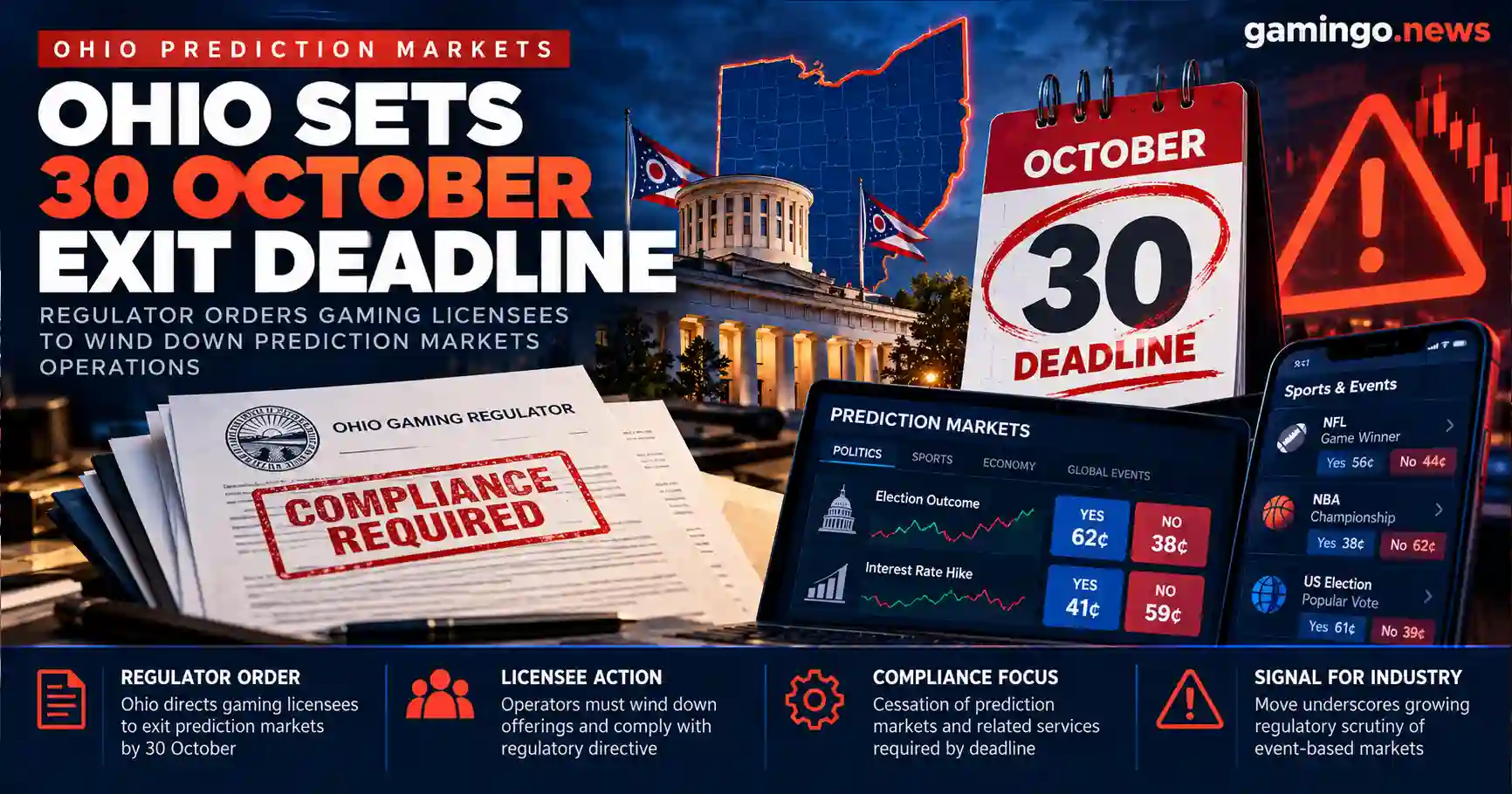
Ohio has told every company it licenses for sports gaming to stop helping prediction markets offer sports event contracts, and to confirm it has done so by 30 October 2026. The Ohio Casino Control Commission (OCCC) is using the one lever it controls directly, license suitability, to reach a market it regards as illegal sports betting.
The notice, dated 20 October and confirmed at the commission's meeting on 21 October, went to sports gaming and fantasy contest licensees and applicants. It is not limited to sportsbooks.
Who and what the notice covers
According to the notice and reporting on it, the OCCC is concerned about licensees supporting unlicensed sports event contracts through:
- liquidity provision and market making;
- integrity monitoring;
- equipment and other technology services;
- data security.
Legal analysis of the notice by Holland & Knight says it also reaches suppliers and vendors and their key employees, certified independent testing labs and integrity monitors working with prediction markets.
Licensees must stop the activity immediately and affirmatively report compliance by 30 October.
The stakes: suitability
"Suitability" is the commission's ongoing judgment that a licensee is fit to hold a license. The notice calls it "a continuing obligation of licensure." Andromeda Morrison, the OCCC's interim executive director, said licensees that keep supporting prediction markets "may impact their future and ongoing suitability."
Possible outcomes include reopened suitability investigations, license suspension or revocation, and other penalties. These are risks the notice describes, not penalties already imposed; none had been reported. The OCCC first warned licensees about prediction markets in August 2025.
The platforms themselves
The licensee notice follows direct action against the platforms. In early October the OCCC sent cease-and-desist letters to 10 companies offering sports event contracts in Ohio, with a 16 October deadline to confirm compliance:
| Company | Company |
|---|---|
| Coinbase | Polymarket |
| Gemini Titan | ProphetX |
| Moomoo Financial | Robinhood |
| Novig | Underdog |
| Plus500US Financial Services | Webull Financial |
Kalshi was left off the list because it is already in litigation with the commission. Polymarket has sued the OCCC in the Southern District of Ohio, arguing that its letter violates the Commerce Clause and is preempted by the Commodity Exchange Act. Morrison said the commission will "vigorously defend Ohio's sports gaming laws." Gov. Mike DeWine has reportedly directed Attorney General Andy Wilson to start suing operators that do not comply, noting that enforcement actions "are not self-executing."
Why Ohio feels confident: the Sixth Circuit
In late September 2026 a unanimous Sixth Circuit panel sided with Ohio and Tennessee against Kalshi. It held that Kalshi's sports event contracts are not swaps under the Commodity Exchange Act, and that even if they were, federal commodities law does not preempt state sports betting laws. It upheld the Ohio federal court's refusal to block the state and vacated an injunction Kalshi had won in Tennessee.
The ruling binds federal courts in Ohio, Kentucky, Michigan and Tennessee. It does not settle the question nationally. A 2-1 Third Circuit decision in New Jersey's case reached the opposite result, and New Jersey has asked the U.S. Supreme Court to resolve the split, backed by 39 states, Washington, D.C., 146 tribal nations and organizations and the NFL. New Jersey announced that petition alongside its new mandatory responsible gambling rules.
What licensees should do before 30 October
- Inventory every relationship with a prediction market platform or its affiliates: liquidity, market making, data, odds, integrity, testing, hosting and security.
- Decide which fall within the notice and stop them.
- Document the review, the decisions and the dates, and keep the records.
- Report compliance to the OCCC by the deadline.
- Plan the exit: contract termination, data retention and handover, without destroying records the commission may want.
- Check other states. Similar questions are being asked by regulators in Michigan and North Carolina, and tribes have opposed Kalshi in Maryland.
The wider question
Ohio is testing whether state gambling regulators can use licensing to police a market that sits, for now, under a federal regulator, the CFTC, whose approach has divided stakeholders. If the Supreme Court takes New Jersey's case, the answer will come from Washington. Until then, Ohio licensees face a simple choice: their Ohio license, or their prediction market business in Ohio.
Status reviewed on 23 October 2026. More regulation news and North America coverage.
Frequently asked questions
What is Ohio's prediction market deadline?
30 October 2026. By then, Ohio sports gaming and fantasy contest licensees and applicants must stop the prediction-market-related activities covered by the OCCC's 20 October notice and affirmatively report that they have complied.
Does Ohio's warning apply only to sportsbooks?
No. It covers licensees and applicants that provide services to sports event contract platforms, including liquidity, market making, integrity monitoring, equipment, data security and other technology. Suppliers, vendors and their key employees, certified testing labs and integrity monitors are within reach.
Has Ohio revoked any gaming licenses over prediction markets?
No. The notice warns that continued support may affect a licensee's suitability, which the OCCC calls a continuing obligation of licensure. Possible consequences include reopened suitability investigations, suspension, revocation or other penalties, but none had been reported as imposed.
Which prediction market companies received cease-and-desist letters in Ohio?
Coinbase, Gemini Titan, Moomoo Financial, Novig, Plus500US Financial Services, Polymarket, ProphetX, Robinhood, Underdog and Webull Financial, with a 16 October deadline. Kalshi was not included because it is already in litigation with the commission. Polymarket has sued the OCCC in federal court.
What did the Sixth Circuit decide about Kalshi?
In late September 2026 a unanimous Sixth Circuit panel sided with Ohio and Tennessee. It held that Kalshi's sports event contracts are not swaps under the Commodity Exchange Act and that, even if they were, federal commodities law does not preempt state sports betting laws. A 2-1 Third Circuit decision in New Jersey's case went the other way, and New Jersey has asked the U.S. Supreme Court to resolve the conflict.