
Swedish Trade Body BOS Says EU AML Fine Plan Risks Double Punishment for Gambling Operators
BOS told Sweden's Finance Ministry that AML fines on gambling firms should use Swedish gross gaming revenue, not group turnover, as EU rules land in 2027.
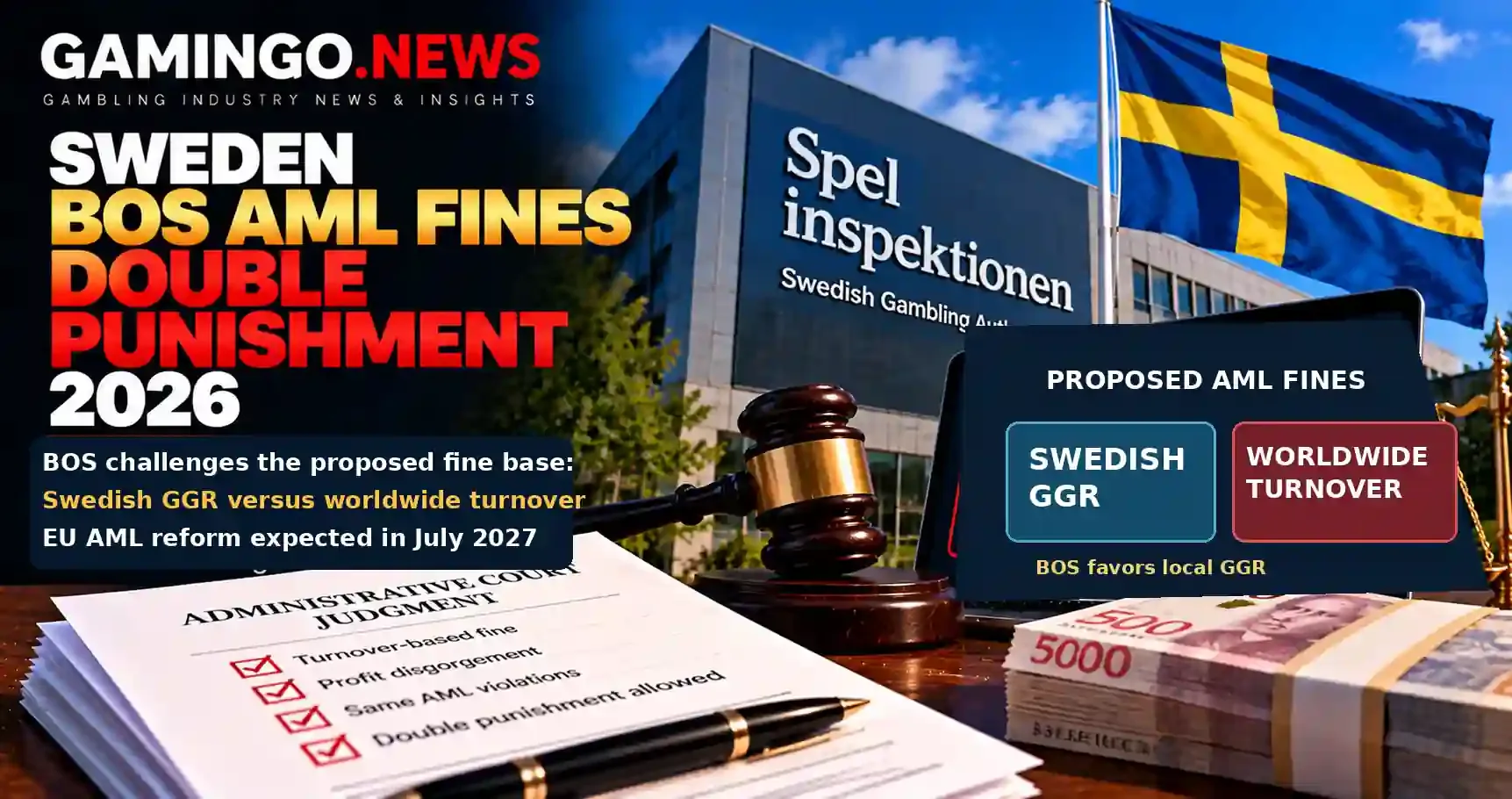
Branschföreningen för Onlinespel (BOS), the trade association for licensed online gambling operators in Sweden, has told the Ministry of Finance that fines for anti-money laundering (AML) failures should be calculated on an operator's Swedish gross gaming revenue rather than its worldwide group turnover, warning in a consultation response filed by the 30 October 2026 deadline that the alternative could turn a single fine into double punishment for multinational groups. The response concerns the ministry's plan to rewrite Sweden's AML law to fit the European Union's 2024 AML package.
BOS broadly supports the reform and higher penalties. Its objection is to the base on which fines would be set.
What the ministry has proposed
The Ministry of Finance published the memorandum EU:s penningtvättspaket (reference Fi2026/01654) on 6 July 2026 and sent it out for consultation. BOS is one of four gambling bodies on the official list of consultees, alongside the regulator Spelinspektionen, Spelbranschens Riksorganisation and the charity lotteries' association.
| Item | Detail |
|---|---|
| Document | Memorandum EU:s penningtvättspaket, Fi2026/01654 |
| Published | 6 July 2026 |
| Consultation deadline | 30 October 2026 |
| Main start date | 10 July 2027 |
| Replaces | Money Laundering Act, beneficial ownership Register Act, account and safe-deposit box system act |
The memorandum would replace the current Money Laundering Act with a new law that gathers supervision and sanctions powers in one place, widen the range of businesses covered, expand the beneficial ownership register, and give the Financial Intelligence Unit within the Swedish Police more power to share information and freeze accounts. A new national register of accounts, safe-deposit boxes and virtual IBANs would cover gaming accounts too.
The timing follows the EU's Anti-Money Laundering Regulation (AMLR), which applies directly in every member state from 10 July 2027. The package, proposed by the European Commission in 2021 and adopted in 2024, also created the EU Anti-Money Laundering Authority (AMLA). Gamingo reported on the European Parliament's vote when the EU passed its new anti-money laundering regulation.
BOS's two objections
Group turnover. According to iGaming Business, the association objects to fines for conduct in Sweden being linked to the total turnover of an operator's group. Many Swedish licensees belong to multinational groups licensed in several countries. BOS says only Swedish turnover should count, because a group-wide figure "creates clear risks of double punishment," in its words, contrary to Swedish and EU law.
Stakes versus revenue. BOS also wants the base to be gross gaming revenue (GGR), meaning stakes minus winnings paid to players. Its example: of SEK100 staked, about SEK95 typically goes back to players, so only SEK5 is the operator's revenue. It compares this to banks, whose fines are tied to their own turnover rather than to customer deposits.
| Basis for a fine | What it counts | BOS position |
|---|---|---|
| Group turnover | Revenue of the whole corporate group, in every market | Opposes |
| Swedish turnover (stakes) | All money staked by Swedish players | Opposes |
| Swedish GGR | Swedish stakes minus winnings paid out | Supports |
Secretary general Gustaf Hoffstedt said the rules need a rethink to "ensure proportionality, avoid double punishment" and give legal certainty, as quoted by iGaming Business.
The 2023 ruling BOS relies on
The revenue argument has already been tested in court under the Gambling Act (spellagen). On 9 May 2023, in HFD 2023 ref. 25, the Supreme Administrative Court (Högsta förvaltningsdomstolen) ruled in a case brought by Genesis Global that "turnover" for capping a fine means the licensee's net revenue under good accounting practice, with player winnings deducted from stakes. Spelinspektionen had used stakes before winnings. The court sent the fine back to the regulator to recalculate, while upholding the warning, which concerned Genesis's connection to the national self-exclusion register Spelpaus.
AML penalties fall under the separate Money Laundering Act, and BOS wants the same revenue principle written into its successor. It has pressed the point before; Gamingo covered its AML checklist and industry initiatives against money laundering in 2024.
Recent AML fines in Sweden
Spelinspektionen has been imposing AML fines regularly, and operators have been losing appeals. In early July 2026 the Administrative Court (Förvaltningsrätten) upheld warnings and fines against three companies, finding they had let customers keep playing despite risk signs such as very large deposits.
| Operator | Fine upheld |
|---|---|
| Spooniker | SEK10 million |
| Betsson Nordic | SEK6.5 million |
| Snabbare | SEK5.5 million |
| Total | SEK22 million |
Earlier cases include the Videoslots AML fine and the Casino Cosmopol SEK2 million AML penalty. The regulator also updated its anti-money laundering guidance for licensees in 2025.
What happens next
The ministry will review the consultation responses before drafting a government bill for the Riksdag, Sweden's parliament. To meet the EU start date, the new law would need to pass in time for 10 July 2027. The response from BOS has not yet been posted on the government's consultation page, which so far lists answers from other bodies.
Status reviewed on 30 October 2026. Memorandum details and the consultation deadline are from the government's pages; BOS's arguments are as reported by iGaming Business, as the response itself was not yet published. More regulation news and EMEA coverage.
Frequently asked questions
What is BOS asking the Swedish government to change?
BOS, the Swedish trade association for online gambling, wants AML penalties for its members calculated on the revenue they earn in Sweden after paying out winnings, known as gross gaming revenue. It objects to the idea of using an operator's total group turnover, which would include income earned in other countries. BOS says that approach risks punishing the same company twice and conflicts with Swedish and EU law.
What is the EU AML package and when does it apply in Sweden?
The EU AML package is a set of laws adopted in 2024. It includes a directly applicable Anti-Money Laundering Regulation, a new directive and a new EU Anti-Money Laundering Authority based in Frankfurt. The regulation applies in all member states from 10 July 2027. Sweden's Ministry of Finance has proposed new national laws, mainly taking effect on the same date, to fit the package.
How are gambling fines calculated in Sweden today?
Under the Gambling Act, the Supreme Administrative Court ruled in May 2023, in a case involving Genesis Global, that the turnover used to cap fines means the operator's net revenue, with player winnings deducted from stakes. Spelinspektionen had used gross stakes. BOS wants the same principle applied to AML penalties under the Money Laundering Act and its successor.
Have Swedish gambling operators been fined for money laundering failures recently?
Yes. In July 2026 an administrative court upheld warnings and fines imposed by Spelinspektionen on Betsson Nordic (SEK6.5 million), Snabbare (SEK5.5 million) and Spooniker (SEK10 million). The court found the companies had let customers keep playing despite risk indicators such as very large deposits, and had delayed enhanced checks.


