
Why Illegal Online Casinos Keep Winning in Germany and France
Discover why Germany and France continue to struggle against Europe's growing iGaming black market despite stricter regulation.
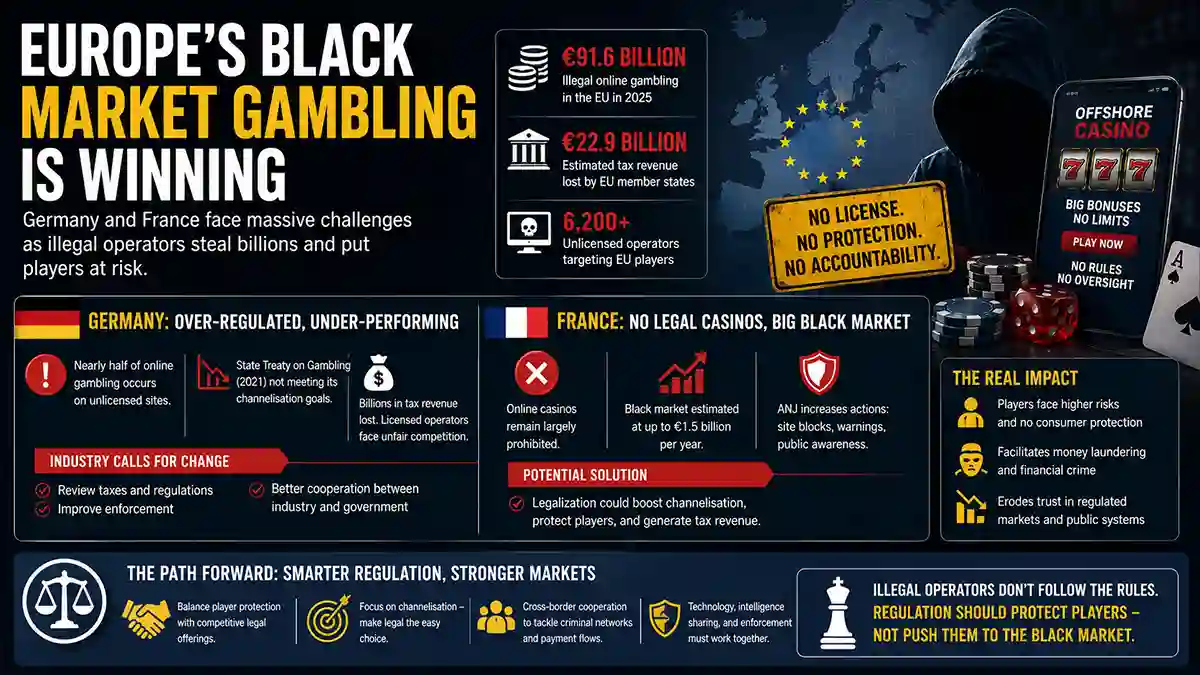
Europe has spent years tightening gambling regulations. Yet illegal operators continue to gain market share. That should tell regulators something uncomfortable: stricter rules alone don't stop the black market.
Germany and France offer two very different regulatory models. One has a regulated online casino market. The other still largely prohibits online casinos. Surprisingly, both face the same outcome. Players continue migrating to offshore gambling sites that offer fewer restrictions, bigger bonuses, and a smoother experience.
If you're an operator, affiliate, investor, or regulator, this isn't just another policy debate. Understanding why players abandon licensed platforms is essential to predicting where Europe's gambling market is heading next.
Let's examine why Germany and France continue to struggle against illegal gambling, what regulators have learned, and why smarter regulation—not simply more regulation—may be the only long-term solution.
What You'll Learn
- Why Germany's regulated market still struggles with channelisation.
- How France's casino ban fuels offshore gambling.
- Why players continue choosing illegal operators.
- What Europe can learn before the black market grows even larger.
Europe Isn't Losing to Illegal Gambling by Accident
On paper, Germany and France should have very different online gambling markets.
Germany legalized online casinos under the State Treaty on Gambling, introducing one of Europe's most heavily regulated licensing systems.
France, meanwhile, still prohibits most forms of online casino gambling while allowing sports betting, horse racing, and poker.
Different laws.
Different regulators.
Different political strategies.
Yet both countries continue fighting the same opponent.
The illegal gambling market.
That should raise an obvious question.
If two completely different regulatory approaches produce similar results, perhaps the problem isn't simply enforcement.
Perhaps it's the regulatory model itself.
Germany Built a Legal Market—But Many Players Never Joined It
When Germany introduced nationwide online casino regulation in July 2021, expectations were high.
The objective was straightforward.
Move players away from offshore casinos and into licensed platforms where consumer protection, taxation, and responsible gambling measures could operate effectively.
That objective remains only partially achieved.
Multiple industry studies suggest a significant portion of German online gambling activity still takes place on unlicensed websites.
The exact figures vary depending on methodology, but the conclusion remains remarkably consistent.
The legal market has not captured enough players.
For regulators, this creates a difficult dilemma.
If consumers continue preferring offshore casinos, regulation cannot fully achieve its intended purpose.
Why Offshore Casinos Remain Attractive
This isn't difficult to understand.
Illegal operators generally offer exactly what many players want.
- Larger welcome bonuses
- Higher deposit limits
- Faster registration
- Crypto payments
- Fewer affordability checks
- Thousands of slot titles
- Progressive jackpots
- Minimal restrictions
Germany's licensed market looks very different.
Strict stake limits.
Mandatory waiting periods.
Centralized player monitoring.
Advertising restrictions.
Extensive identity verification.
Each rule may have a legitimate public policy objective.
Collectively, however, they also create friction.
Players notice friction.
And many simply look elsewhere.
Industry Groups Want Regulation Reviewed
German gambling associations have become increasingly vocal.
Organizations including the German Online Casino Association (DOCV) and the German Sports Betting Association (DSWV) have repeatedly argued that the current framework requires adjustment.
Their position isn't that regulation should disappear.
Quite the opposite.
They believe regulation should work more effectively.
That means creating a licensed market capable of competing with offshore operators rather than unintentionally driving customers toward them.
Several areas frequently appear in industry discussions:
- Gambling taxation
- Product restrictions
- Licensing procedures
- Advertising rules
- Enforcement against illegal operators
The underlying message is simple.
A legal market only succeeds if players actually choose it.
France Has a Different Problem
France presents an almost opposite situation.
Instead of heavily regulating online casinos, France has largely refused to legalize them.
The result has been predictable.
Demand never disappeared.
It simply moved offshore.
Millions of French players continue accessing international casino websites because no domestic alternative exists.
History has repeatedly demonstrated this principle.
Prohibition rarely eliminates demand.
It usually relocates it.
ANJ Faces an Uphill Battle
France's gambling regulator, Autorité Nationale des Jeux (ANJ), has intensified its campaign against illegal operators.
Authorities continue blocking websites.
Payment providers receive warning notices.
Internet service providers cooperate with enforcement actions.
Public awareness campaigns encourage consumers to avoid unlicensed gambling sites.
These efforts certainly disrupt illegal operators.
They rarely eliminate them.
New domains appear.
Mirror websites launch.
Alternative payment methods emerge.
The technology moves faster than enforcement.
That's the reality regulators increasingly face.
Legalization May Be the Better Weapon
For several years, policymakers have debated expanding France's regulated gambling market to include online casinos.
Supporters believe legalization could significantly increase channelisation while generating substantial tax revenue.
Critics worry about gambling-related harm and addiction.
Both arguments deserve consideration.
However, one fact remains difficult to ignore.
The black market already offers online casino gambling to French consumers every day.
The policy question isn't whether online casinos exist.
It's who controls them.
Licensed operators.
Or offshore businesses beyond French regulatory oversight.
The Real Cost of the Black Market
Lost tax revenue often dominates political discussion.
Yet financial losses represent only part of the problem.
Illegal operators typically provide:
- Limited consumer protection
- Weak responsible gambling tools
- Minimal dispute resolution
- Unverified game fairness
- Poor AML controls
Players often assume every online casino follows similar standards.
That assumption can become expensive.
When something goes wrong at an offshore casino, recovering lost funds or unpaid winnings becomes extremely difficult.
Regulation exists for a reason.
Its effectiveness, however, depends on players actually using licensed operators.
Europe Needs Better Balance
Across Europe, regulators increasingly emphasize responsible gambling.
That's understandable.
Protecting vulnerable players should remain a priority.
But successful regulation also depends on market competitiveness.
If licensed casinos become too restrictive while illegal operators remain easily accessible, the market naturally shifts toward unregulated alternatives.
This isn't speculation.
It's happening already.
Germany illustrates what happens when regulation becomes highly restrictive.
France demonstrates what happens when regulation doesn't exist at all.
Neither outcome appears ideal.
The most successful gambling jurisdictions typically achieve something in between.
They combine strong consumer protection with commercially attractive legal products.
Finding that balance is far harder than writing another regulation.
ICE London and Europe's Next Regulatory Debate
As industry leaders gather at events such as ICE, one subject consistently dominates conversations behind closed doors.
How do you increase channelisation?
Not how many websites were blocked.
Not how many fines were issued.
But how many players voluntarily choose licensed gambling.
Because that's ultimately the only statistic that matters.
A regulated market succeeds when players prefer it—not when they're forced into it.
Conclusion
Germany and France have taken very different regulatory paths, yet both continue struggling against the same expanding black market.
That should be a wake-up call for policymakers across Europe.
Good regulation isn't measured by the number of restrictions it creates. It's measured by how many players stay inside the legal market. If regulators want to weaken illegal gambling, enforcement alone won't be enough. They must also build licensed markets that players genuinely want to use. When legal gambling becomes less attractive than offshore alternatives, the black market doesn't need to compete—it simply waits for customers to arrive.
📢 Join the Conversation!
Want to share your thoughts or ask questions about our latest articles? Stay connected and be part of the discussion by joining our Telegram and WhatsApp channels!
🔹 Get real-time updates 🔹 Share insights with industry peers 🔹 Ask questions & get expert answers
👉 Join us on Telegram 👉 Join us on WhatsApp
Let’s keep the conversation going!
- ANJ
- Europe iGaming black market
- France gambling
- France Online Casino
- Germany Gambling
- GGL Regulation
- ICE 2024
- ICE London 2024
- iGaming Black Market
- iGaming regulation
- Illegal Casinos
- Illegal Gambling


