
Austrian Finance Committee Backs Online Gambling Licensing Bill, With Licences Valid From October 2027
Austria's Nationalrat Finance Committee approved the Gambling Act amendment on 24 November 2026, opening online gambling to multiple licensed providers.
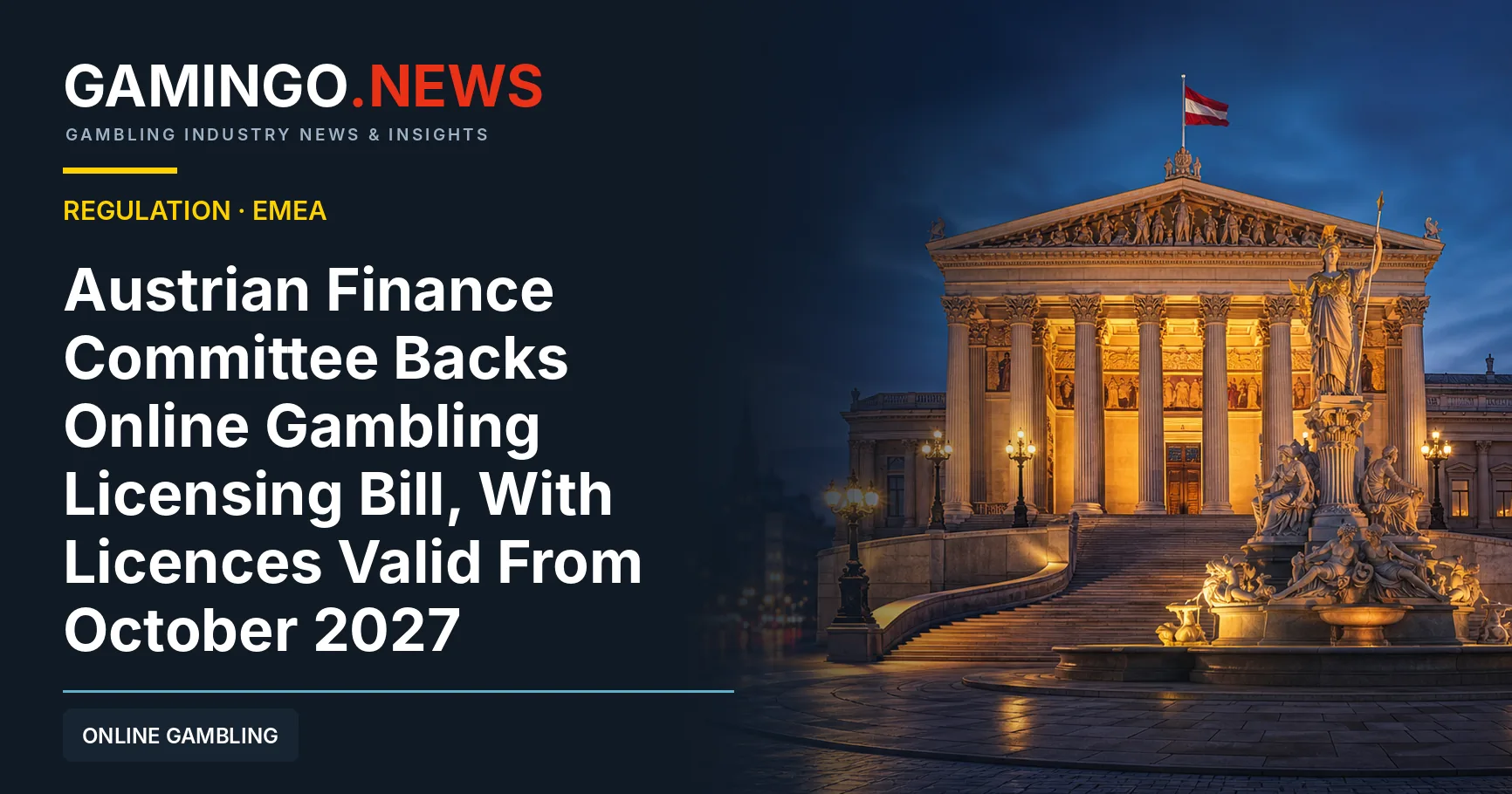
The Finance Committee (Finanzausschuss) of Austria's Nationalrat approved an amendment to the Gambling Act and the Telecommunications Act on Tuesday 24 November 2026, advancing a bill that would open online gambling to multiple licensed providers.
The government bill, numbered 594 d.B. (XXVIII. GP), passed with the votes of ÖVP, SPÖ and NEOS. The FPÖ and the Greens criticized it. The parliamentary release does not state a vote count. The committee decision is not final passage: the bill still needs a vote in the Nationalrat, the lower house of Austria's parliament.
What the bill changes for online gambling
The bill replaces a closed system with a strictly regulated licensing regime in which several providers can operate. ÖVP MP Gabriel Obernosterer described it as a move from a closed single-licence system to an open one that also raises state revenue. Austria's earlier position is covered in Gamingo's report on the decision to maintain the online casino monopoly and in the EGBA's call to end the monopoly.
The licensing rules set out in the release are:
| Element | Detail |
|---|---|
| Licence grants | Possible from 1 January 2027 |
| Licence effect | From 1 October 2027, described as a cooling-off phase |
| Unlicensed operators | Providers active in Austria without an Austrian licence must stop their offering by the end of 2026 to qualify |
| Eligibility | Only companies that have settled tax debts and met all final judgments from player-protection lawsuits |
Operators therefore cannot go live on 1 January 2027, even if a licence is granted on that date. Gamingo's earlier coverage of the €10 million barrier attached to Austria's new gambling licence gives context on the entry cost.
Player protection and enforcement powers
The bill pairs market opening with new controls. Player-protection measures include:
- A central exclusion register (Sperrregister).
- Mandatory deposit limits that apply across providers.
- Limits on virtual slots.
- Stricter technical rules for machines: a €5 maximum stake per game, a two-second minimum game speed, and a 15-minute break after every 90 minutes of play.
Certain tightened protections for machines already approved under state law apply only from 2031.
Enforcement tools include network (website) blocking and payment blocking. The Amt für Betrugsbekämpfung, Austria's fraud-prevention office, would carry out covert test gambling. A new Gambling and Player Protection Unit (Stelle für Glücksspiel und Spielerschutz) would handle market monitoring and scientific support.
Finance Minister Markus Marterbauer said the law lifts player protection to a "new level". He said it brings the large share of illegal providers, some already licensed elsewhere in the EU, into legality. A Finance Ministry expert told the committee that technical preparations for implementation are under way.
Criticism in committee
Greens MP Nina Tomaselli argued the bill favors providers and focuses on state revenue. Her objections were:
- It extends licences for video lottery terminals (VLTs) and state-licensed "Landesautomaten".
- It lets foreign casinos advertise at a "cheap rate".
- The per-game stake limit rises from €1 to €5 for individually placed machines.
- Exclusions apply only when the minimum subsistence level is at stake.
- The protections do not apply in domestic casinos.
FPÖ MP Maximilian Linder said he was "irritated" that previously illegal providers can apply for licences. A ministry expert replied that the VLT extension avoids a licensing gap that would benefit the illegal market, and that the advertising permission is time-limited. SPÖ's Christoph Matznetter and NEOS's Karin Doppelbauer also supported the bill.
EU standstill and timing
Austria notified the draft to the European Commission's Technical Regulation Information System (TRIS) on 4 August 2026 under notification 2026/0415/AT. The standstill period, during which a member state should not adopt the measure, was due to end on 5 November 2026 and now ends on 7 December 2026. The Commission submitted comments and Malta submitted a detailed opinion. According to iGamingBusiness, Malta's opinion led to the extension; the TRIS page lists the new date without giving a reason.
iGamingBusiness also quotes Vienna lawyer Arthur Stadler as expecting passage before Christmas 2026 and describing the window between ratification and 1 January 2027 as tight for applicants. That is a practitioner's expectation, not an official schedule.
Other European markets are moving in a similar direction; Gamingo has tracked how Finland advanced its bill to launch a competitive market. For Austria, the key dates are the end of the TRIS standstill on 7 December 2026, the Nationalrat plenary vote, and the end-of-2026 cutoff for unlicensed providers seeking eligibility.
Status reviewed on 26 November 2026. Dates, vote details and bill provisions come from the Austrian Parliament's 24 November release and the European Commission's TRIS notification. More regulation news and EMEA coverage.
Frequently asked questions
When can online gambling licences be issued in Austria under the new bill?
Under the bill approved by the Finance Committee, new licences can be granted from 1 January 2027, but they only take effect from 1 October 2027. That gap is described as a cooling-off phase, so licensed operators cannot launch on 1 January 2027.
Has Austria's new Gambling Act amendment become law?
No. The Nationalrat Finance Committee approved the bill (594 d.B.) on 24 November 2026, but committee approval is not final passage. The bill still requires a vote in the Nationalrat plenary. The EU standstill period for the draft also runs until 7 December 2026.
Which operators can apply for an Austrian online gambling licence?
Licences go only to companies that have settled tax debts and met all final judgments from player-protection lawsuits. Providers that were active in Austria without an Austrian licence must end their offering by the end of 2026 to qualify, according to the parliamentary release.
What player-protection measures does the Austrian gambling bill include?
The bill introduces a central exclusion register (Sperrregister), mandatory deposit limits that apply across providers, limits on virtual slots, and stricter machine rules: a €5 maximum stake per game, a two-second minimum game speed and a 15-minute break after every 90 minutes of play.
What is TRIS notification 2026/0415/AT?
It is Austria's notification of the draft Gambling Act and Telecommunications Act amendment to the European Commission's Technical Regulation Information System. Austria notified it on 4 August 2026. The standstill period was due to end on 5 November 2026 and now ends on 7 December 2026.
- Austria
- Austria gambling reform
- Austria online gambling license
- Gambling Monopoly
- MultiLicensing
- Gambling Legislation
- 2026 Gambling Law
- Licensing System